
Many Australian organisations are talking about neuroinclusion, but far fewer know where they actually stand. You can read more about the background, importance, and benefits of being a neuroinclusive organisation in our previous blog: Neuroinclusion in Australian Workplaces. An organisation may have introduced flexible working, provided neurodiversity training, established an employee resource group, or even made adjustments to recruitment processes. While these can all be valuable initiative, they also raise a more difficult question: “How do you know whether your organisation is genuinely neuroinclusive, and what should you do next?”
At Q Inclusion, we developed the Neuroinclusion Position Index (NPI) to help organisations answer exactly that.
The Neuroinclusion Position Index provides organisations with a structured, evidence-informed way to understand their current position on neuroinclusion, identify strengths and gaps, and establish their priorities for improvement. Meaningful neuroinclusion is not a single policy, training session, or workplace adjustment; it is a characteristic of the organisation itself. Therefore, rather than asking whether an organisation has implemented a collection of individual neurodiversity initiatives, the NPI looks at the broader organisational environment in which neurodivergent people work.
From good intentions to real change
The Neuroinclusion Position Index is designed to help make move an organisation from one that is doing neuroinclusive activities to one that is neuroinclusive.
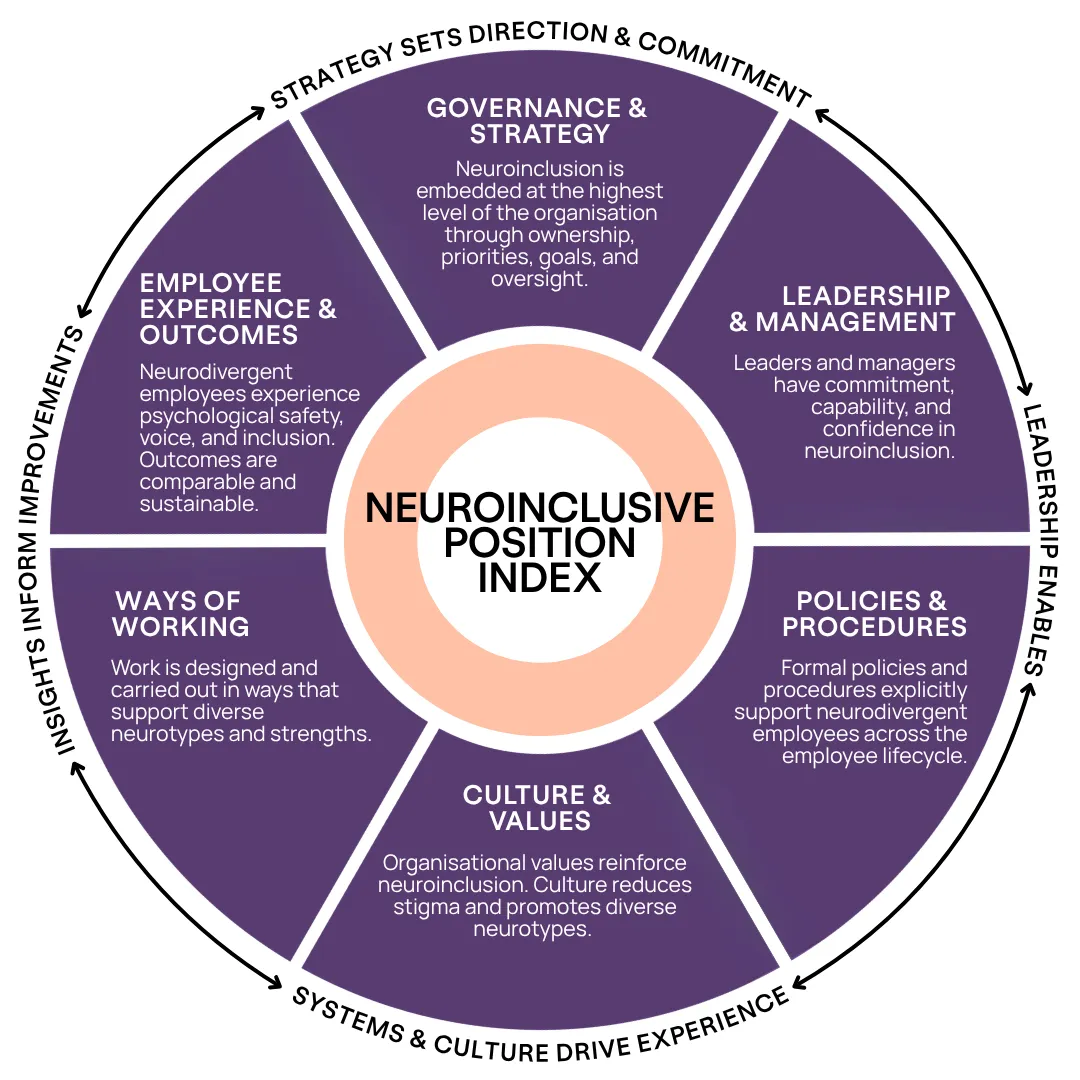
Rather than simply asking what initiatives an organisation has implemented, the NPI examines the conditions that shape the everyday experiences of neurodivergent people across the organisation. It considers neuroinclusion across interconnected areas of organisational life, from governance, strategy, and leadership through to employee experience and ways of working. The result is a clearer picture of an organisation's current neuroinclusive position.
Importantly, this is not about giving organisations a pass or fail, it is about answering a much more useful question: “Where are we now, and where should we focus next?”
What is the Neuroinclusion Position Index?
The Q Inclusion Neuroinclusion Position Index is an organisational assessment framework designed to evaluate an organisation's current approach to neuroinclusion and translate those findings into practical priorities for improvement.
The Neuroinclusion Position Index was built by the Q Inclusion team following an extensive review and examination of the scientific literature regarding neuroinclusion. It contains a comprehensive model outlining the key layers, standards, and compliance considerations required to make an organisation truly neuroinclusive. The NPI represents the most contemporary understanding of neuroinclusion science and evidence, interpreted and actioned by Q Inclusion to the benefit of organisations.
Using its inbuilt maturity model, organisations are evaluated on the Neuroinclusion Position Index layers, standards, and compliance elements to understand their current neuroinclusion position and to highlight the specific areas they are currently embedding neuroinclusion in the organisation and, importantly, where transformation is needed. It provides organisations with a systematic way to move beyond assumptions about how inclusive they are and develop a clearer understanding of their strengths, gaps, and opportunities.
Through the Neuroinclusion Position Index, we examine neuroinclusion at all levels of an organisation rather than focusing only on the experiences or needs of individual employees. This matters as many barriers experienced by neurodivergent employees are not individual problems requiring individual solutions, instead they are features of workplaces.
Recruitment processes can create unnecessary barriers. Meetings can privilege particular communication styles. Offices can create sensory demands. Policies can require employees to navigate complicated processes to access flexibility. Leadership expectations can reward one particular way of communicating, collaborating or demonstrating competence. Although these practices may appear individually relatively minor, they collectively shape who can participate comfortably and successfully within an organisation.
Set your organisation up for transformation
Measurement is only valuable if it leads somewhere. For this reason, the Neuroinclusion Position Index is not intended to produce a score that sits in a report. Its primary purpose is to guide transformation and improvement.
The assessment helps establish an organisation's current position and identify where meaningful change is likely to have the greatest impact, creating a foundation for a more strategic approach to neuroinclusion.
Instead of attempting to change everything simultaneously, or selecting initiatives because they are visible, popular, or relatively easy to implement, organisations can prioritise action based on identified organisational priorities and needs. For example, some organisations may discover that they already have strong policies in place but need to focus on implementation and leadership capability. Others may have an inclusive culture at the team level but significant structural barriers embedded within recruitment, performance management, or workplace systems. Others still may be at an earlier stage and need to establish the fundamental governance, strategy, and organisational capability required to embed neuroinclusion.
There is no assumption that every organisation starts from the same place, and that is precisely why understanding their position matters.
A roadmap for becoming more neuroinclusive
The ultimate value of the Neuroinclusion Position Index is not simply knowing where your organisation currently sits, it is knowing what to do with that information. Q Inclusion can support organisations to develop a practical roadmap for improvement, helping to determine which changes should be prioritised, how different initiatives connect, and what a more mature approach to neuroinclusion could look like over time.
This changes the conversation from: "What neurodiversity initiative should we introduce next?" to "What are the most important changes our organisation needs to make to become more neuroinclusive?" - that is a fundamentally different approach. That is the approach of an organisation looking to become truly neuroinclusive.
It moves neuroinclusion away from a series of disconnected activities and towards deliberate organisational development. In this way, neuroinclusion is not simply about supporting a minority of employees. It is about designing better organisations.
Where does your organisation sit?
For many organisations, the hardest part of improving neuroinclusion is knowing where to begin. For others, significant work is already underway, but there is no clear way of understanding whether those initiatives are addressing the most important organisational barriers. The Neuroinclusion Position Index provides a starting point for both journeys. It creates an opportunity to examine your organisation systematically, understand where progress has already been made and identify where further attention is required. Most importantly, it provides a foundation for moving from good intentions to deliberate, evidence-informed organisational change.
The question is no longer simply whether organisations value neurodiversity, the more important question is: “Has your organisation been designed so neurodivergent people can genuinely participate, contribute, and thrive?”
How can Q Inclusion help?
Q Inclusion partners with organisations to assess and understand their current approach to neuroinclusion and develop practical, evidence-informed pathways for improvement. We can support you with our Neuroinclusion Position Index to help your organisation understand where it is today, identify its priorities, and build and deliver a roadmap towards a more neuroinclusive future.
Talk to us about assessing your organisation's Neuroinclusion Position.